Gloria Gaynor’s song, “I will survive” played in my head as I drove to the conference facility last month where I was to teach a two-day workshop. While questioning my decision to accept such an assignment, I reminded myself of all of the protocols that were put in place in order to ensure a safe and comfortable session for me and the 14 participants coming from near and far.
After everything was said and done, my worrying and careful planning paid off. The workshop was highly successful!
You may be wondering exactly HOW I managed to make it happen during these COVID-filled times. In fact, I couldn’t find much written to help guide me on this topic. So, in an effort to help you, here are my tips for delivering an in-person, worry-free workshop.
Tips to Ensure a Safe, Sanitized, and Successful Session
Measure the Room
This is probably the most important piece of advice for your future planning. Consider the total square footage of the room, the number of people in attendance, the type of workshop that you are doing, and how much physical interaction is required between participants.
The room initially suggested by the facility would have been too small for the participants to move around in without getting in each other’s way. We realized that we needed at least six feet in all directions for the presenter and 36 square feet for each participant. As a result, we ended up using half of a ballroom with six-foot long tables for 14 people. We also added an extra row of rectangular tables that we used during the dyad and triad exercises to provide adequate social distancing on all sides.
Bottom line: Be sure to determine where each person can safely sit before the room is accepted and used.
Make Mask-Wearing Mandatory
This was a non-starter as far as I was concerned. And, most participants inquired about this policy before they came to class. They were all willing to comply.
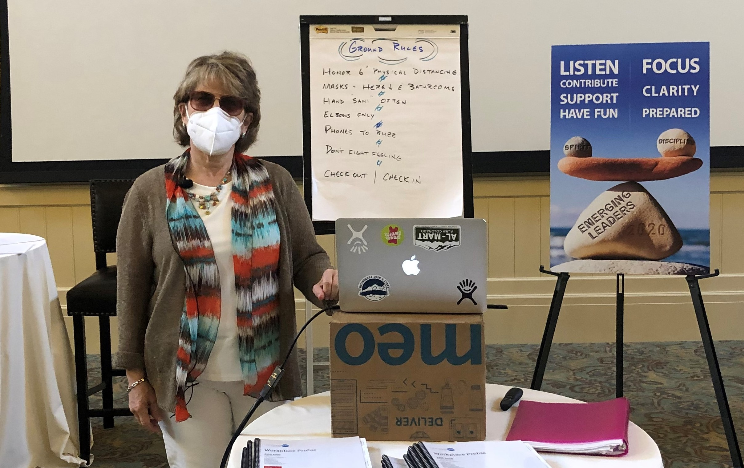
Besides taking everyone’s temperature each day, we required that everyone wear a mask throughout the day – except when eating or drinking. And I had to “walk the talk” and keep my mask on while facilitating the class. Using a lavalier microphone was key in helping people understand what I was saying from the front of the room. It was a minimal expense for a big return.
We did take frequent breaks so that people had a breather – going outside for fresh air or just into the large lobby. The agenda was modified to include more breaks; we limited large group exercises; and, we had no shared resources such as flip chart markers or sticky notes.
Create COVID-Friendly Ground Rules
Discuss the ‘elephant in the room’ early in the first day. I reviewed our “Rules of Engagement” so that there were no misunderstandings or confusion. These rules were sent out ahead of time so that everyone knew what was expected prior to joining the class. If they couldn’t agree to abide by these rules, then they couldn’t attend this session.
We included things like:
- Honor six feet physical distancing
- Masks on inside – classroom & bathrooms
- Hand sanitize often
- Air “High Fives” with elbows only
Provide a COVID-Friendly Goody Bag
If budget will allow, give each participant a mask, mini-hand sanitizer, highlighter, pen, sticky pad, and anything else that is better not shared in the classroom. We even provided each participant with their own Sharpie to use on a flipchart. Everyone loved having a little goody bag at their seat. It made the event more exciting and showed our appreciation for everyone that attended the session.
Additionally, we had hand sanitizer and disinfecting wipes spread all around the classroom, even by the coffee urns. Other than shared coffee dispensers, everything else was either individually wrapped or boxed from breakfast, lunch, snacks and beverages.
Appoint a “COVID Captain”
Asking for a volunteer to be the “COVID Captain” was essential to the smooth running of the workshops.
This enabled me to focus on the content while a participant focused on carrying out the CDC Guidelines. The person who helped me did the following daily:
- Reminded people about mask etiquette when they forgot how or when to use them.
- Took out their tape measure and in a fun & silly way measured the 6’ space between people during group exercises.
- Offered squirts of hand sanitizer or wipes as needed and in a lighthearted way.
- Took temperatures and air elbowed “High Five” after seeing the normal results.
- Assumed responsibility to keep the classroom COVID compliant.
Discuss Everything AHEAD of Time With Your Client
Getting buy-in to all of the above is essential for a smooth workshop. I was fortunate that my client was willing to accommodate all of my requests. We were on the same page with safety. However, I know of many trainers who realize all-too-late that there is a disconnect between the client’s definition of a COVID-safe environment and theirs. It’s best to surface your needs prior to accepting the engagement.
Have Fun!
Despite all of the restrictions, we laughed, we learned, and we adapted. By the time the 2-day session was complete, the masks and other COVID restrictions were long forgotten.
Adapting to this new normal will take getting used to, for sure. However, by following these recommendations, returning to the classroom in a safe and successful way is very possible.
Here’s hoping that these insights will help you to not only survive but to thrive! Please contact me if you are interested in booking a safe and successful in-person workshop.